

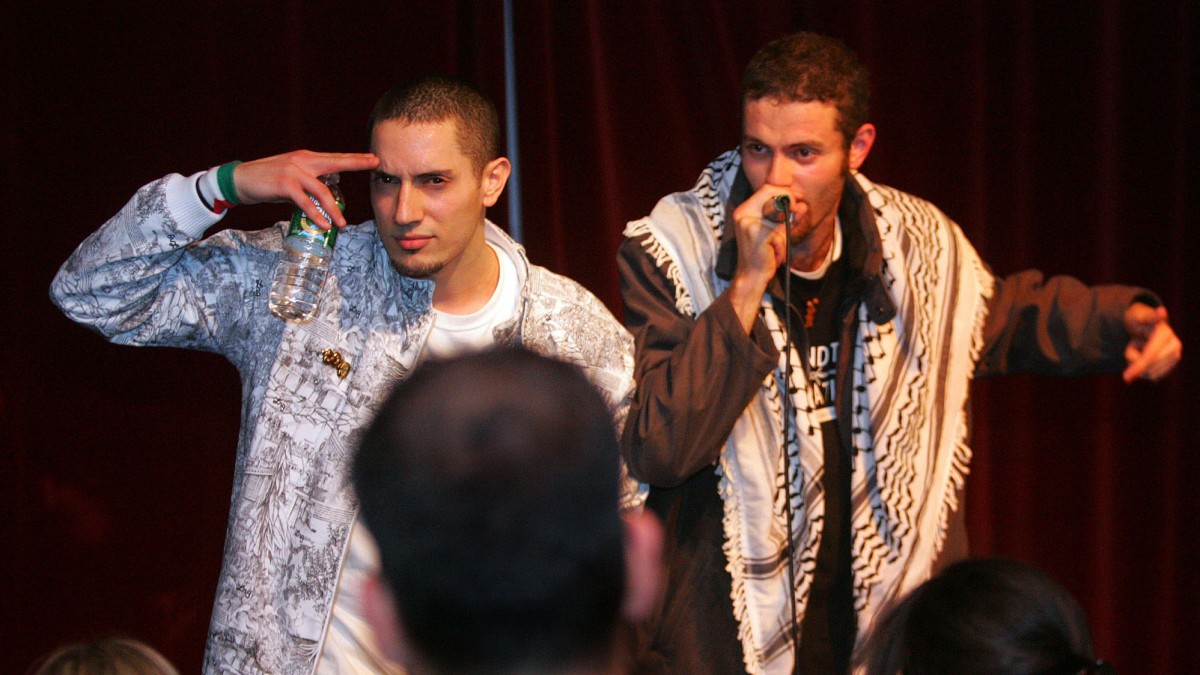

(MintPress)— “I heard em say /The revolution won’t be televised/Aljazeera proved ‘em wrong/Twitter has him paralyzed /80 million strong/And ain’t no longer gonna be/terrorized/Organized – Mobilized – Vocalized /On the side of TRUTH!” Syrian-American poet and rapper Omar Offendum wrote those lyrics about the 2011 demonstrations in Tahrir Square which sparked the Arab Spring in his song “#Jan25Egypt”.
Almost overnight, the song became an international sensation on the web.
Hip-hop music, however, is moving beyond sheer entertainment, and quickly becoming a vehicle for social change across the world.
Today, hip-hop artists and industry insiders are raising their voices in protest of injustice and in favor of peace on diverse issues ranging from the events of the Arab Spring to the oppression of Palestinians in Israel.
Even the U.S. State Department sees the value in the music – so much so, in fact, that since 2005, the entity has been using hip-hop music for purposes of diplomacy.
Hip-hop: A history of activism
Since 2005, the U.S. State Department has been using hip-hop as a bridge for foreign cultural diplomacy. Operating under the auspices of then-public diplomacy undersecretary Karen Hughes, of the “Rhythm Road” program, began sending “hip-hop envoys” to, mostly, the Middle East, hoping to promote transnational understanding through music and dance.
The State Department’s embracing of hip-hop tells just how big and how powerful the genre has become across the globe. “Rap has spread everywhere,” writes Julianne Escobedo Shepherd, associate editor at AlterNet.
“The State Department is using hip-hop as a diplomatic concern in an effort to piggyback and control it, yet hip-hop has already been its own diplomat. Notoriously begun in the South Bronx of New York in the mid 1970s, flourishing despite urban blight and extreme disenfranchisement by the government, as it grew as a phenomenon its spirit resonated across the world. Nearly every country across the globe has its own interpretation of hip-hop—Russia, Denmark and Turkey, as well as Tunisia and Morocco and Algeria—and not just because it conveyed cool cache. The rebellious notion of it, and the fact that it’s a really effective way to express political malcontent, translates across cultures and languages (Public Enemy’s rise to global popularity in the late 1980s certainly had a hand in it.)”
And in recent memory, the music became inextricably linked from the protests of the Arab Spring.
Arab Spring and hip-hop go hand-in-hand
On Jan. 25, 2011, the day of the first major demonstration in Tahrir Square in Cairo, Offendum, aka Omar A Chakaki, went to his studio in Los Angeles and wrote the verses calling for the overthrow of the former president, Hosni Mubarak. He then called a few friends and fellow rappers, the Iraqi-Canadian and Dubai-born Yassin Alsalman – more widely known as the Narcicyst and HBO Def Poet Amir Sulaiman – in Atlanta.
Freeway, an American Muslim MC, in Philadelphia, and the Palestinian-Canadian R&B vocalist Ayah also jumped on board with the project, each writing a portion of the song which would be produced by Sami Matar, a Palestinian-American composer from California, and become a YouTube sensation in just three short days. The song even attracted the attention of international media.
“First and foremost, it’s a song of solidarity with the Egyptian people, who’ve inspired us with their incredible, incredible resolve these past few weeks,” Offendum said in an interview with Al-Jazeera in February of 2011, when asked about his motives in writing the song. Beyond that, he also expressed a desire to impact the thoughts of people in the U.S. on what was happening in the Arab World in 2011, stating he hoped the music would “open it (events of the Arab Spring) up to an audience in the United States that perhaps doesn’t think they have anything to do with the events in Egypt. By getting notable rappers from the U.S.to speak on this issue, hopefully will make them realize that it does affect them,” Offendum said.
He and the Narcicyst were then invited to Dearborn, Mich. a few weeks later for From Gaza to Detroit, a benefit concert for the New York-based NGO Existence is Resistance, together with leading Arab Diaspora voices in the genre, including the British-Palestinian Shadia Mansour, Iraqi-British Lowkey, also known as Dennis Kareem, and the Libyan-American Khaled M.
The music isn’t just having a hand in promoting peace, it’s also promoting greater understanding of world affairs and educating American audiences on the plight of those outside the U.S. “The Arab uprisings have changed Arabic hip-hop by greatly raising the profile of Arab rappers across the world and spurring intensive collaboration among them,” concluded Ulysses, a prominent blogger who writes on Revolutionary Arab Rap and examines social and political change in the Middle East and North Africa through the lens of Arabic hip-hop in a recent piece featured on OpenDemocracy.
“Honestly, its just about the spirit of resistance, and that’s something about hip-hop as an artform and as a culture has always embodied,” Offendum said. “It’s really just about getting this idea out that it’s a universal struggle for human rights that we really just want to kind of align ourselves with and let the people of Egypt know we’re a part of.”
Rapping for peace
Libyan-born rapper Khaled M., who grew up in Lexington, Ky., is « really trying to get people excited about lyrics again,” according to an interview he did with Urban Cusp. “I’m trying to take it back to the days when rhyming actually mattered.”
Khaled hasn’t had an easy life. His father, Fathi, who was part of a revolutionary movement in Libya, was imprisoned for his role in a student protest against the government and was sentenced to life in jail before his eventual execution when Khaled was a young boy. After being tortured in prison for five years, Fathi escaped incarceration. Khaled spent the first few years of his life on the run, moving frequently, as his father fought to avert attempts on his life.
In one of his recent songs, “Can’t Take Our Freedom,” Khaled’s lyrics weave his father’s struggle in Libya along with struggles experienced by many in the Arab world culminating in the Arab Spring revolt. He writes, “In the Darkest Hour/When the world has turned away/And no one’s watching/When the sky has turned to gray /And you have no options /When your voice is illegal/Only choice for the people/Is to stand up proudly/In the face of death/It ain’t a waste of breath/When you speak up loudly/On behalf of the kids in the street with no pot to piss in/Living/ on their own cause their papa’s missing/Don’t know if he’s dead or he’s locked in prison/Disappeared, they considered him the opposition/And now I’m having visions and dreams I shouldn’t see/Like could we be this close? Nah couldn’t be/But if the people in Egypt and Tunis could do this, decide their fate … then why wouldn’t we?”
Khaled, who now travels across the world performing his music, believes that hip-hop is more than just mere entertainment. “There is no question hip-hop is global. Countries like Japan, Brazil, France and Germany have embraced hip-hop to the point where American indie artists get more love out there than back home. In countries facing oppression, like Libya, hip-hop has become a voice for the people. It allows the downtrodden to be heard when traditional means [of media] marginalized them. For a long time, international hip-hop mimicked that of the U.S. Clothing, content, etc. was similar. But, now, we see a wave of countries that are developing their own identity in the hip-hop world. One thing that is beautiful about hip-hop in many countries overseas is that it truly is about the music. There’s less politics when dealing with radio, labels, video channels, etc. It’s truly easier for an independent artist to rise to the top, and that’s something that is slowly catching on here in the U.S.”
And it’s not just artists who are noticing the power of hip-hop to transform social conditions, but some other prominent people associated with the music industry are getting on board with creating coexistence.
Peace in the Middle East: Courtesy of hip-hop?
Last week in Jerusalem, hip-hop mogul Russell Simmons, founder of Def Jam, a major hip-hop record label, and creator of clothing fashion lines Phat Farm, Argyleculture and American Classics, held a press conference with Orthodox rabbi Marc Schneier, vice president of the World Jewish Congress and a prominent rabbi, at the Hamptons Synagosue in New York.
Simmons, who is not Jewish or Muslim, but has been a long-time advocate for greater tolerance and understanding towards Muslims in America and has partnered with Schneier to promote the Foundation for Ethnic Understanding (FFEU), an organization that they co-founded, which is dedicated to strengthening Muslim-Jewish relations around the world.
Their first project, called the twinning program, brings together Jewish and Muslim communities for weekend-long engagements during which they build joint programs and partnerships designed to launch long-lasting cooperation.
Working with the World Jewish Congress and the Islamic Society of North America, the FFEU has “twinned” hundreds of communities, sending imams to meet with Jewish congregations in synagogues and rabbis to speak in mosques.
“It’s a simple idea but it’s not being done,” says Simmons, who has also been outspoken for environmental, animal and gay rights, as well as the Occupy Wall Street Movement, attended the President’s Conference, an annual four-day gathering of thinkers and leaders in Jerusalem focusing on the Middle East.
“We share the firm belief that it is high time Jews and Muslims learnt how to trust and fight for each other – not against one another,” explains Schneier. “And for that, you have to actually know each other,” Simmons told independant Arabic news site Bikya Masr.
Right now, the duo is trying to persuade the Grand Mufti of Jerusalem, Muhammad Ahmad Hussein, to meet one of Israel’s chief rabbis as part of their program.
Hip-hop sheds light on Israel-Palestine
Beyond entertainment and being an important beacon for peace, hip-hop music in the context of the Israeli-Palestinian struggle serves an important function. It helps to build bridges between Palestinians and Jewish Israelis, forming a shared historical narrative and cultural experience.
On this topic, Dr. David Moshman, a professor of psychology at the University of Nebraska-Lincoln, says, “Palestinians are largely absent, appearing only as terrorists, refugees and primitive farmers — the three ‘problems’ they constitute for Israel. As an obstacle or a threat to be overcome or eliminated … their stories, their suffering, their truth or their human faces cannot be included in the narrative.They are simply Arabs who do not belong where they have lived for centuries. » Education about Israel and Palestine in the United States is equally ideological.”
Moshman says in his article on the topic in the Huffington Post that to solve this problem, both Jewish Israelis and Americans need to hear the voices of Palestinians, which can be heard in novels, stories, poems, songs, films, websites and even in the musical genres of rap and hip-hop.
Many Palestinian hip-hop artists like DAM, Mahmoud, Gaza Arapeyat and the Hammer Brothers address themes that directly affect Palestinians in the occupied territories, living in Israel and those in exile.
But, while the phenomenon of Arab hip-hop is certainly gaining popularity and making headlines, it’s not necessarily something new. As Ulysses point out, “While the Arab uprisings certainly strengthened the social and political consciousness of Arabic hip-hop, that consciousness was already quite strong before 2011. The Arab uprisings gave Arabic hip-hop a new energy, vitality, and inter-connectedness, and in Libya and perhaps Tunisia, it could be said that they have sparked a ‘revolution’ in the Arab world’s hip-hop scenes.”
Despite the toppling of dictatorships in places like Egypt, Tunisia and Libya, the beat goes on for hip-hop artists, who will undoubtedly pick new battles to rap about . “Freedom isn’t given by oppressors/It’s demanded by oppressed /Freedom lovers – Freedom fighters/Free to gather and protest for their God-given rights for a Freedom of the Press/we know Freedom is the answer The only question is … Who’s next?” Offendum’s song concludes.