


The page that is still up
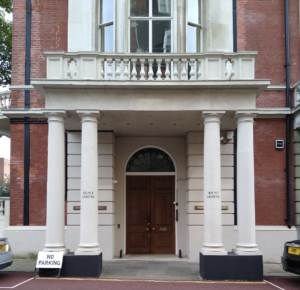
Westminster Synagogue sits in the exclusive Knightsbridge district of London. In the financial year 2024, it brought in a total income of £1.31 million (U.S.$1.75 million).
Its “Ways to Support” page still lists appeals that go well beyond a collection plate. Two of them explicitly note that the money is going towards helping the troops of the Israeli Defense Forces (IDF).
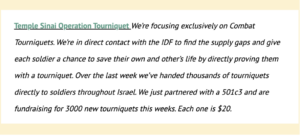
The first is Temple Sinai Operation Tourniquet: a plan to supply the IDF with thousands of medical kits. The copy the synagogue reprints is logistical, not pastoral, noting that:
“We’re focusing exclusively on Combat Tourniquets. We’re in direct contact with the IDF to find the supply gaps and give each soldier a chance to save their own and other’s life by directly proving them with a tourniquet. Over the last week we’ve handed thousands of tourniquets directly to soldiers throughout Israel. We just partnered with a 501c3 and are fundraising for 3000 new tourniquets this weeks. Each one is $20.”
That paragraph lives on a British charity site. The campaign itself sits on the ShulCloud form of Temple Sinai of North Dade, a Reform congregation in North Miami Beach that names “Support for the People, Land, and State of Israel” among its standing values.
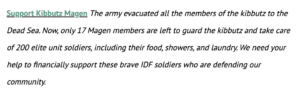
The second is Kibbutz Magen. The synagogue’s own pasted text is blunter still about who is being bankrolled:
“The army evacuated all the members of the kibbutz to the Dead Sea. Now, only 17 Magen members are left to guard the kibbutz and take care of 200 elite unit soldiers, including their food, showers, and laundry. We need your help to financially support these brave IDF soldiers who are defending our community.”
Civilian reconstruction can, if tightly drawn, sit inside poverty or humanitarian objects. This paragraph does not ask only for roofs in Be’eri. It asks readers to “financially support these brave IDF soldiers.” Food, showers and laundry for two hundred elite-unit troops are field-kitchen and billet costs. In other words, it is support for a foreign army.
The first Internet Archive capture of the support page is dated July 12, 2025, so the page has been live at least since then. The IDF installations at the kibbutzes themselves most probably went up in early 2024, in the first wave of post-October appeals. Either way, trustees have had a long time to read their own site against the Commission’s published ruling.
What the objects actually say
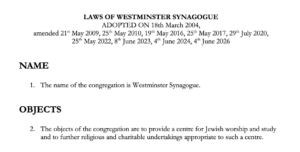
The Charity Commission register states Westminster Synagogue’s objectives in one sentence: “to provide a centre for Jewish worship and study and to further religious and charitable undertakings appropriate to this.”
The 2024 trustees’ report repeats the same formula; “what the charity does” is religious activities. Who it helps is children, older people, and other charities. And how? By providing human resources and services to the people of Westminster, London.
There is no objective that says “supply combat kits to a foreign army.” None that mentions “paying for the food, showers and laundry of two hundred elite soldiers.” And certainly no mention of “acting as a British shop-window for an American 501(c)(3) that boasts of filling IDF ‘supply gaps.’”
Trustees must further the purposes in the governing document. They must not apply charitable status, Gift Aid wrapping, or the congregation’s website to something that is not a charitable purpose at all. Shockingly, Westminster Synagogue donors are eligible for Gift Aid. This allows the Synagogue to reclaim £0.25 in each £1 received in membership fees or donations.
The line the Commission has already drawn
In January 2025, the Charity Commission regulator issued an official warning to Chabad Lubavitch Centres North East London and Essex Limited.
That charity’s purposes were ostensibly promoting orthodox religion, education, and the relief of poverty and sickness. But in October 2023, it started a fundraising page for “Aron Dov Sufrin’s reserve unit” – the son of the Chabad Rabbi, Aryeh Sufrin, who was serving with the IDF. The page raised about £2,280 (just over U.S.$3,000). Trustees sent £937 (around U.S.$1250) to the soldier, and could not account for the spend. The rest went on “non-lethal military equipment” bought by the trustees and shipped to the same man.
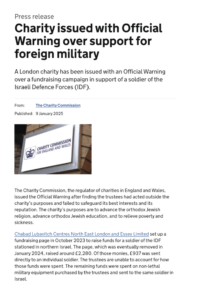
The Charity Commission investigated the Chabad Lubavitch Centres North East London and Essex, and issued an official warning to the group. In explaining the decision, Helen Earner, then-director for regulatory services at the Charity Commission, said the sentence that should be taped above every fundraising page in the sector: “It is not lawful, or acceptable, for a charity to raise funds to support a soldier of a foreign military.”
Although British charities are allowed to aid the U.K. armed forces, “Providing aid or military supplies to any foreign armed force is not a charitable purpose, and no charity can legally undertake such activity,” it stated.
More than 180 complaints triggered that case. The commission called the activity outside the charity’s purposes, not capable of being charitable, and a breach of trust.
This ruling is highly relevant to the case of the Westminster Synagogue. Chabad sent supplies to one soldier and received an official warning. Westminster reprinted a drive that claims to have already handed thousands of tourniquets already to soldiers, with three thousand more on order. It also asks donors to fund the food and laundry of 200 elite Israeli soldiers carrying out a genocide.
The legal distinction is not “non-lethal.” Chabad’s leftover cash went on non-lethal kit. Laundry soap and a field canteen are also non-lethal. The Charity Commission still said no. A tourniquet is issued so a combatant can keep fighting after limb trauma. Hot meals and showers for an elite unit are how that unit stays in the line. Both are support for a foreign army.
Two asks, one problem
It is worth putting the two Westminster Synagogue appeals side by side, because a trustee may try to split them.
Operation Tourniquet is hardware. Combat application tourniquets are IDF standard issue. The organisers say they hand them “directly to soldiers” and that they are “in direct contact with the IDF.”
Kibbutz Magen is sustainment. The synagogue text says the army evacuated the members, that seventeen people remain, and that those seventeen are “left to guard the kibbutz and take care of 200 elite unit soldiers, including their food, showers, and laundry.” The last sentence does not hide the beneficiary: “financially support these brave IDF soldiers who are defending our community.”
A border kibbutz that wants civilian trauma care is one thing. A paragraph that treats the IDF company on its lawn as the object of the collection is another. The Magen description states the civilians have been sent to the Dead Sea. The people still on site, in even the synagogue’s own telling, are the unit and their minders.
If the commission meant what Earner said, both projects fail to meet the definition of a charity. One fails as it is providing military kit to a foreign army. The other fails as it is providing welfare services to that same force. Neither is “a centre for Jewish worship and study.”
Building Swimming Pools For the IDF
The Chabad warning did not arrive in a vacuum. By its 2025–26 annual report, the Charity Commission said it had opened over 400 regulatory cases since October 2023 “in the context of the escalation of conflict in the Middle East.” In addition, it had made over 80 police referrals. That file includes charities on both “sides” of the genocide. Only a fraction are about fundraising for a foreign army — but that subset is the one Earner wrote the rule for.
Mizrachi UK — legally Mizrachi (UK) Israel Support Trust (registered U.K. charity number 1137199), the operating religious-Zionist charity at the London School of Jewish Studies — is the closest published parallel to Westminster’s “we only hosted the appeal” line. In March 2025, the Commission began assessing a complaint from the International Centre of Justice for Palestinians over Facebook and newsletter appeals for tactical helmets, ceramic plates and other kit for IDF soldiers.
On 18 November 2025 it issued an official warning. Mizrachi UK trustees had promoted, on Facebook and its website, an external appeal “to provide equipment to soldiers in a foreign military.” That purpose, the commission said, did not further their objectives for the public benefit; promoting it was not in the charity’s best interests and risked its reputation. There was no evidence that Mizrachi’s own funds bought the kit; promotion was enough. The register still carries a regulatory alert.
Westminster’s tourniquet paste-up and the Kibbutz Magen appeal to “financially support these brave IDF soldiers” are the same species of act: a UK charity platform used to tout support for a foreign army.
UK Friends of the Association for the Wellbeing of Israel’s Soldiers (AWIS, registered U.K. charity number 1084272) is the case that tests whether the commission means what Earner said. The regulator opened a compliance case because of concerns the charity was fundraising for military support for the IDF — which, they stated, “would have been unlawful and outside of the charity’s objects.” Inspectors later said they found no misapplied funds. They still issued an official warning in July 2025, but only over a distressing combat video and over trustees who had outsourced the website. The public site has stayed down.

That outcome sits oddly against the commission’s own rule, and against what the charity had already put on camera. Its registered objects are to support serving and discharged Israeli soldiers through education and leisure. The Israeli partner is the body that describes itself as the channel for donations to IDF soldiers and units. A May 2023 Facebook video, cited in reporting on the U.K. arm, shows the project “created a swimming pool in the heart of the desert for the training base of the artillery corps.” The same reporting records an annual “enlistment festival” for some 30,000 recruits. A pool on an artillery training base and a festival that marks joining the army are not a village leisure centre with a Star of David on the gate. They are infrastructure and pageantry for a foreign force.
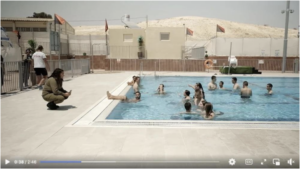
Chabad Ilford sent non-lethal kit to one soldier and caught an official warning, because that purpose is “not capable of being charitable.” Mizrachi UK promoted an equipment appeal and caught one even though its own cash was not shown to have bought the plates. AWIS helped fund a swimming pool for the IDF and a recruitment gala for tens of thousands of conscripts, and the finding was: funds inside objects: warn them about a video. Either a desert pool for the artillery corps is “leisure” that happens to sit on a firing range, or the commission applied a different test to a charity whose objects already name Israeli soldiers as the class. Westminster’s tourniquet paste-up and the Magen drive to feed “200 elite unit soldiers” will be argued under whichever of those two readings the regulator now prefers. The question is whether that preference is the law, or the postcode.
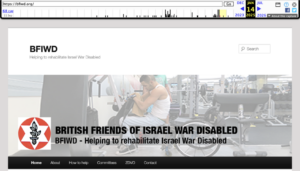
Complaints also appear to have been made against The British Friends of the Israeli War Disabled Trust (registered charity number 269269), the long-running British fundraising arm for wounded members and ex-members of the armed forces of the Jewish State. As I reported in August 2025, it had brought more than 5,000 potential war criminals to the U.K. to be hosted by British Jewish families. After those complaints, the public website was shuttered. The objects on the register were explicit about who the money was for: “members, or ex members of the Armed Forces of the State of Israel.” That is the same foreign army. The Commission’s published rule does not create a welfare exemption that turns military beneficiaries into a charitable purpose they would not otherwise be. Magen’s “food, showers, and laundry” line is that welfare exemption argued in plain English — and it is still an ask for IDF soldiers.
UK Toremet Limited (registered charity number 1140972) is the donor-advised platform that processes other groups’ appeals so U.K. donors can wrap Gift Aid around them. The Islamic Human Rights Commission has twice written to the Commission about Toremet pages that routed money towards IDF equipment, such as vests, helmets, drones. Declassified UK later documented grants via Toremet for PTSD treatment of Yahalom combat engineers. Police have been notified about other Toremet flows into the occupied West Bank. Toremet says it cooperates and that restricted grants stay restricted. The point for Westminster is simpler: the Commission already knows this pipeline exists.
Acheinu Limited (registered charity number 1131948), which operates under the name, The Boys Clubhouse, was highlighted in the same post-October wave. The commission looked at an event featuring a British man who had been fighting with the IDF in Gaza. Acheinu’s objects are poverty, education and recreation for Jewish children and young people. Hosting a homecoming for a foreign combatant is not those objects. The register still lists “Israel” among areas of operation.
Westminster is not Chabad, Toremet or Acheinu. It is a progressive London synagogue with a Holocaust-scrolls museum in the basement. That is why the page matters. If the rule is real, it applies in Knightsbridge not just in Stamford Hill.
What the law allows — and what it does not
English charity law is not, or at least should not be, a vibe. Purposes must fall inside the Charities Act headings. Advancing religion can cover worship, study, pastoral care, and grants that further those things. The relief of poverty can cover civilians in need. The promotion of the efficiency of the U.K. armed forces is a recognised purpose. The armed forces of another state are not.
Therefore, a synagogue may:
- run services and study
- raise for its own building and school
- send pastoral or humanitarian grants that stay inside religion, education or poverty
- point members to another charity whose objects are lawful
It may not:
- raise for a named soldier of a foreign army
- buy or tout military kit for that army, “non-lethal” or not
- pay, or ask others to pay, for the food, showers and laundry of elite-unit troops
- act as the British noticeboard for a campaign that says it is in direct contact with the IDF and is putting kit into soldiers’ hands
Gift Aid makes the breach worse, not better. A taxpayer top-up on a donation that is not charitable is a public subsidy for a private political project.
Trustees also have a duty to protect reputation. Hosting an IDF supply appeal and an IDF-billet appeal on the same domain as High Holy Day bookings is a reputation fact, whether or not a pound has yet left Kent House.
The other “ways to support”
The tourniquet and Magen appeals do not stand alone. The same page asks for money for the Kibbutz Movement, Kibbutz Be’eri, Sha’ar HaNegev and Kibbutz Nir Oz; for partner congregation Kol Haneshama in Jerusalem; for Leket; and for the New Israel Fund’s crisis appeal.
Those neighbouring items are the camouflage. Rebuild Be’eri, feed displaced families, stock a partner place of worship. Readers in a hurry could tell themselves the whole list is humanitarian. It is not. Two entries on that list name IDF soldiers as the people who eat, wash, sleep and bleed with the kit.
The congregation marks Yom Ha’atzmaut (“Israel Independence Day”) with Jewish National Fund, the Zionist Federation and the World Zionist Organisation. Its conversion syllabus includes “History of Ancient and Modern Israel” in the same week as Yom HaZikaron (the “national” day of remembrance for “fallen” Zionist soldiers) and Yom Ha’atzmaut. An exhibition in Kent House showed photographs from the Western Wall and Masada.
None of that is, by itself, a legal offence. Religion may talk about a land. The offence begins when the charity website moves from talk to inventory and rations for a foreign army.
Who presides over the books?
The president of Westminster synagogue is Howard Leigh, Baron Leigh of Hurley. He is a Conservative life peer, senior treasurer of the party, and sits on the advisory board of Conservative Friends of Israel. He chairs Jerusalem Foundation UK (which builds settlements in East Jerusalem in contravention of international law) and is a vice-president of the peak communal lobby group the Jewish Leadership Council.
Those are declared offices. They explain why a Knightsbridge pulpit is not a quiet backwater. A peer who raises millions for Jerusalem Foundation settlements still has to keep a U.K. charity inside U.K. charity law.
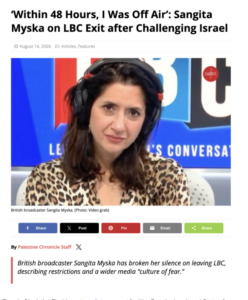
Money also arrives the other way. The Ashley Tabor-King Foundation, the private foundation of Ashley Tabor-King, the man behind Global and LBC radio, has donated to Westminster Synagogue. Stephen Miron, Global’s chairman, sits in the same commercial and communal world, being also a trustee of the charity – brought up in a Zionist synagogue affiliated to United Synagogue in London. Westminster Synagogue is wired into a donor circuit that already treats the Jewish State as a communal given. No wonder LBC Radio host Sangita Myska’s contract was not renewed after she tried to hold an IDF spokesperson accountable. At the same time, company leadership sat on a charity which donated to the Westminster Synagogue where the common sense support of Zionism, and later the genocidal IDF, is baked in.
Temple Sinai, the Florida partner, lists support for “the People, Land, and State of Israel” as a core value. Alan E. Litwak has served as its senior rabbi since 2002. That is their constitution. It is not Westminster’s open charitable purpose.
Why “we only signposted” will not do
A trustee who is tempted to say, “we did not send the money, we only linked to campaigns,” should read the Chabad file again. The misconduct was the fundraising activity. Hosting the appeal, wrapping it in charitable livery, and pointing their flock at the Israeli military was enough.
Westminster’s page does more than link. It pastes the operational paragraphs — IDF contact, thousands of tourniquets already delivered, three thousand more, price per unit; seventeen minders and two hundred elite-unit soldiers who need food, showers and laundry — all under the synagogue’s own headings. A reader of the support page is entitled to think the charity is endorsing the campaigns.
If no tourniquet money and no Magen mess-fund has left Kent House, the trustees can say so to the Commission. They still have to explain why the paragraphs are there, and why they were still there after the Chabad warning of January 2025.
What happens next
The Commission said in the Chabad release that the warning was “a clear message to other charities to stay true to their established purposes.” “Other charities” includes Westminster Synagogue.
A serious complaint will ask the regulator to:
- Capture the live “Ways to Support” page, the July 2025 Archive snapshot, and the Temple Sinai form.
- Require trustees to say when the Tourniquet and Magen blocks were posted, who approved them, and against which object.
- Require them to say whether any Westminster funds, Gift Aid, or staff time went into Operation Tourniquet, Kibbutz Magen, or any other IDF kit or sustainment appeal.
- Compare both blocks with the Chabad Official Warning and with the AWIS case opened on the same legal theory.
- Order the paragraphs down if they cannot be brought inside the objects — and consider an Official Warning if they cannot.
The regulator has the power. It has the precedent. And it has the evidence. What it has not yet done is apply that quote to a well-connected independent synagogue in Knightsbridge.
The findings in this article will be submitted to the Charity Commission. The Commission should look very closely. A rule that bites in Stamford Hill and goes quiet in Knightsbridge is not a rule. It is a preference.
If combat tourniquets “handed directly to soldiers,” and a collection “to financially support these brave IDF soldiers,” are lawful charitable activities in England and Wales, Helen Earner was wrong in January 2025. If she was right, action against Westminster Synagogue’s fundraising efforts needs to be taken.