

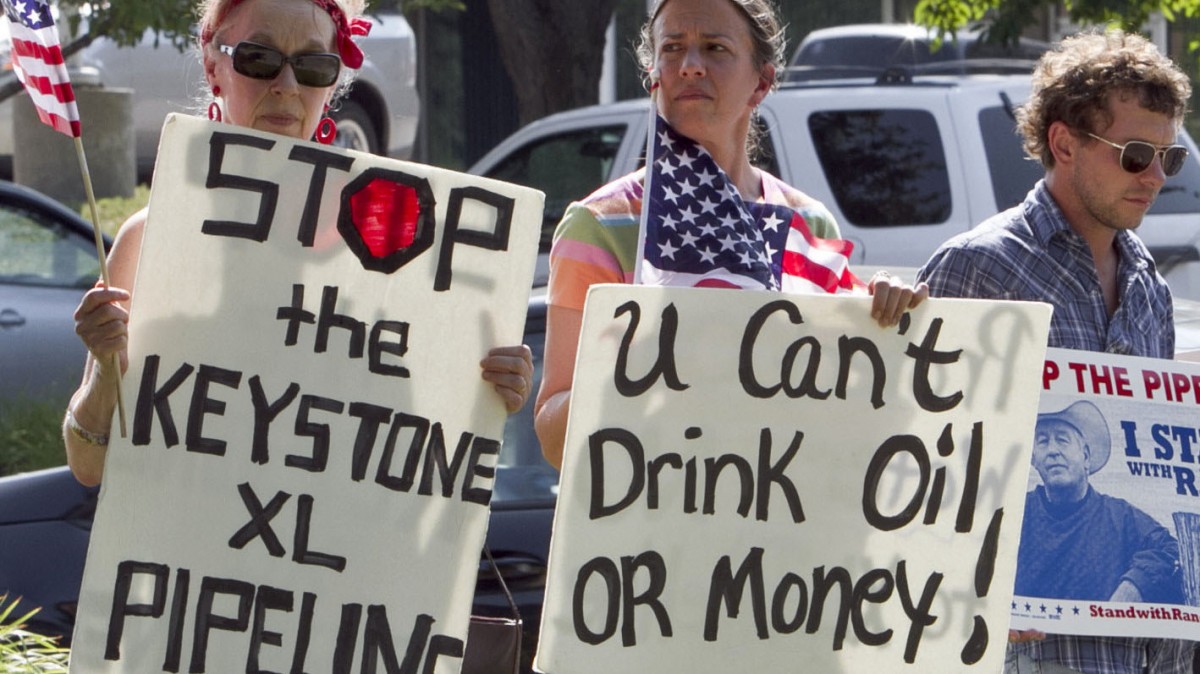
Recent comments made by the head of energy giant TransCanada might have just put the spotlight on the power of the movement to stop the Keystone XL pipeline.
The company’s CEO, Russ Girling, told media this week that TransCanada was looking into the option of transporting crude from the Alberta tar sands by rail, amidst continued delays and uncertainty over Obama administration approval of the pipeline.
« We are absolutely considering a rail option, » Girling told Reuters on Wednesday, adding, « [W]e’re in discussions now with [our customers] over the rail option. »
« It’s not a path that we had envisioned going down, » Girling also said, speaking to Bloomberg, adding that the change « requires modification of our current contractual relationships. »
Girling also mentioned exploring the rail option speaking to The Hill on Thursday, saying that he told his customers his company would look at that option « expeditiously. » The Hill adds:
By the end of 2015, Girling expects 1.2 million barrels per day will be transported via rail by producers.
But it would be no easy task, as the Globe and Mail points out, because getting the tar sands crude from Alberta to the Nebraska-Kansas border to the completed section of the Keystone XL « would also require large numbers of scarce tank cars. »
In addition, Anthony Swift, an international attorney at the Natural Resources Defense Council, told Bloomberg, « To be able to move 800,000 barrels a day of tar sands, » roughly the amount TransCanada expected to pump through the Keystone, « would require the largest off-loading terminal in the world. »
« The few companies engaged in it have indicated that it’s not a particularly profitable business, » Swift said.
The fact that TransCanada is now forced to explore this other method of transporting tar sands « shows how effective that the movement against the Keystone XL pipeline has been, » Scott Parkin, a spokesperson for environmental and social justice group Rising Tide North America, told Common Dreams.
The company’s rail plans may still be « fairly far away, » Parkin said, as « they still face a lot of regulatory hurdles. »
As for the fight against crude transported by rail — the risks of which have been underscored with a series of recent disasters — that is a fight that’s already begun, he said.
Just as activists have put their bodies on the line in efforts to thwart work on the Keystone XL, Parkin said groups like his are engaged in the fight not only against oil by rail but also coal by rail, as well as export terminals.
Girling has previously acknowledged the power of anti-Keystone activists, saying, “There’s no question that the noise outside is having an influence on the process.”
In addition to facing fierce opposition to its Keystone XL pipeline, TransCanada has faced mounting pressure against its proposed Energy East pipeline, which would carry crude from Alberta eastward through Canada to the Maritime provinces.
Like Keystone, « it would be foolish to think this pipeline won’t face serious challenges, » Andrea Harden-Donahue, energy and climate justice campaigner with the Council of Canadians, said in a statement.
This article was originally published on Common Dreams.